

In the vast landscape of human experience, there exists a pervasive illusion: the belief that if we simply plan enough, analyze enough, and worry enough, we can somehow secure a future free of uncertainty. We convince ourselves that there is a destination—a final state of being—where the chaos settles and we finally “have it all figured out.” But this desire for absolute certainty is not a roadmap; it is merely a comfort blanket we pull tight against the cold reality of the unknown.
We live in an era that demands perpetual preparedness. As a result, the mind becomes a “tireless hamster wheel,” spinning through a thousand potential outcomes for events that have not yet occurred. We find ourselves lying awake at 2:00 AM, not merely thinking, but “rehearsing, analyzing, and trying to pre-solve” every conceivable problem of tomorrow

The Architecture of Anxiety: The Hamster Wheel of Control
The pressure to have a plan is really just a symptom of our obsession with control. We treat life like a puzzle that needs to be solved instantly, rather than a journey to be experienced. We convince ourselves that if we just worry enough, or plan enough, we can avoid the chaos.
This behavior often manifests in what I call “The Great Idea Escape.” We have “mind-blowing universe altering ideas” in the shower—solutions that could “revolutionize breakfast” or “solve world peace”. But these moments of clarity are fleeting. Why? Because they are often born of a frantic desire to fix our lives in one fell swoop. When the dopamine of the idea fades, we are left with the reality that life cannot be solved in “30 glorious seconds”.
We treat our lives as equations to be balanced rather than mysteries to be lived. We frantically attempt to control the external world, believing that if we can just predict the future, we can protect ourselves from it. Yet, this internal rehearsal does not bring peace; it only distances us from the reality of the present.
The Stoic Rebuttal: Rationality in an Era of Chaos
Our obsession with control is exacerbated by the modern cultural landscape. We live in an era where we are “bombarded with information, expectations and the relentless pursuit of success”. The pressure to present a curated, “figured out” life is immense. Yet, if we look back to ancient wisdom, we find a compelling counter-argument to this modern neuroticism.
The philosophy of Stoicism serves as a “guiding light” in this darkness. Rooted in “rationality, resilience and emotional control,” Stoicism challenges the very premise of our late-night anxieties. It teaches us that the “chaos” of the external world is inevitable and, more importantly, outside our command.
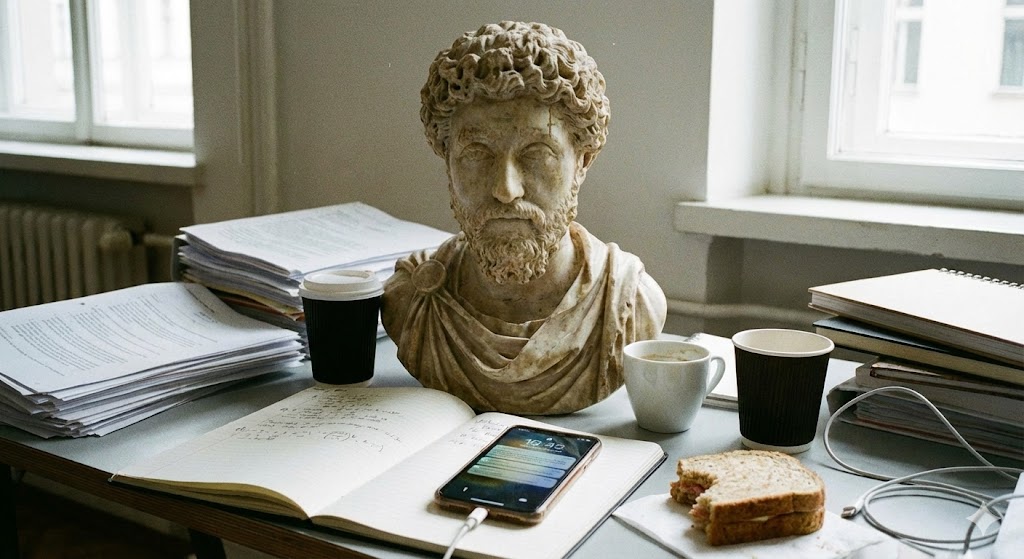
The anxiety we feel at 2:00 AM stems from a category error: we are trying to control the narrative of the future, rather than controlling our own internal response to the present. To claim we have life “figured out” is to claim dominion over fortune itself—a distinctly anti-Stoic, and ultimately futile, endeavor.
The Great Waiting Game: Deferring Happiness
When we fixate on a future state of certainty, we inadvertently devalue the present. We begin to treat our daily lives not as the main event, but as a “loading screen”—a necessary, irritating pause before the real game begins.
We find ourselves trapped in what can be termed “The Great Waiting Game.” We spend an “unholy amount of time waiting.” We wait for success to validate us, for love to complete us, or simply for the weekend to liberate us. This deferral of living creates a hollowness in the human experience.
This aligns with misconceptions regarding happiness, often visualized as a destination we must reach. As noted in the exploration of the PERMA model, we chase happiness “like a squirrel chasing a nut,” convinced it is hidden in a “high-paying job or a dreamy vacation”. But this is a mirage. If we believe that “having it figured out” is the prerequisite for happiness, we condemn ourselves to a perpetual state of lack, forever waiting for a tomorrow that never quite arrives.

IV. The Jungian Shadow: Synchronicity over Strategy
Perhaps the most profound argument against the rigid planning of life comes from the field of depth psychology. The Swiss psychiatrist Carl Gustav Jung challenged the mechanistic view of the universe with the concept of Synchronicity.
Jung observed that there are “seemingly magical moments when the inner world of thoughts, dreams, and emotions appears to mirror itself in external events with uncanny precision”. These moments of meaningful coincidence suggest that life is not a linear puzzle to be solved by logic alone, but a complex web of meaning to be experienced.
When we are too busy trying to force our lives into a pre-conceived structure, we blind ourselves to these synchronistic events. We miss the subtle guidance of the unconscious because we are too focused on the conscious “script” we have written for ourselves. The “inner world” cannot mirror the external if we are squeezing our eyes shut, praying for everything to go according to plan.
V. The Thief with Soft Hands: Returning to Sensation
Ultimately, the myth of “having it all figured out” is a tragic waste of our most finite resource: time. Time is a “thief with soft hands.” It does not steal from us with violence, but in the “quiet moments between then and now”.
While we are busy plotting our trajectory toward a secure future, the sensory richness of the world fades. We miss the “smell of rain-soaked earth” and the simple grounding ritual of the “first sip of morning tea”. We allow the “echoes of childhood laughter” to fade into the background, replaced by the noise of our own ambition.

Even our small, seemingly “pointless rituals”—like carefully rotating a coffee mug before the first sip—are acts of grounding. They are not about efficiency; they are about presence. To discard these moments in favor of a grand five-year plan is to trade the texture of life for a blueprint of it.
Surrendering to the Mess
To abandon the need to “have it all figured out” is not an act of resignation, but an act of courage. It requires us to step off the hamster wheel and accept that the map is not the territory.
It invites us to trade the illusion of certainty for the reality of Synchronicity, and to exchange the “relentless pursuit of success” for the immediate, tactile joy of the present moment. We must stop waiting for the loading screen to end and realize that the uncertainty is the game.
So, the next time you feel like you’re falling behind because you don’t have a ten-year plan, remember: nobody actually knows what they are doing; some people are just better at pretending. Let go of the blanket. Embrace the confusion. Be a work in progress rather than a finished project that sits on a shelf collecting dust.